The world has never been more connected, or more fragile. A single action, whether a subtle shift or a seismic shock, can ripple across continents, upending lives, ecosystems, and economies in ways we can barely grasp. Human achievement has expanded our reach, but in doing so, it has worn thin the buffers that once kept our influence in check. The intricate layers of society, especially the environment, that once fostered equilibrium and stability are unravelling. We stand exposed, unmoored, struggling to find our footing in a world growing ever more volatile.
This fragility is not new, but it has deepened. It first became existential with the creation of the atom bomb, the moment we gained the power to unmake ourselves. Today, that sense of threat lingers on too many fronts to name. At the root of it all is a forgetting, a failure to remember, as Rachel Carson once wrote, that in nature, nothing exists alone. That forgetting has been the recurring story, and tragedy, of history.
Those few words carry immense weight, reminding us that our very existence is bound to the other. Yet we alone, among all creatures, have the freedom to deny this reality. Ensnared by our small self, we fail to recognise the greater Self to which we all belong. Overwhelmed or oblivious to our interdependence, we struggle to act in alignment with it. We need help to make that choice, to see beyond ourselves to the other, to what lies between us. We need simple tools that sharpen our awareness and expand our sphere of concern. This is the purpose of the Relational Imperative.
When one of my kids provokes the other, or when I catch myself doing the same, I remind them (or myself) that they are not only Fred, Lulu, or Amie, but also a Gill. And in a family, hurting someone always hurts you too. They might not feel it right away, but they eventually will.
Moments like these don't just arise. They're shaped by what's already stirring within us. The quiet tug of frustration, the pull of pride, the need to be right or seen, these often surface before a word is even spoken. There's a widely shared story, often attributed to Cherokee tradition, that speaks to this inner dynamic.
One evening, an elder tells his grandson about a battle that takes place inside every person. “My son,” he says, “the battle is between two wolves. One is evil — it is anger, envy, jealousy, sorrow, regret, greed, arrogance, self-pity, guilt, resentment, inferiority, lies, false pride, superiority, and ego. The other is good — it is joy, peace, love, hope, serenity, humility, kindness, compassion, empathy, generosity, truth, and faith.” The grandson thinks for a moment, then asks, “Which wolf wins?” The elder replies, “The one you feed.”
Yet it is not only your own wolf you feed. Every choice you make, every word you speak, every small act of kindness or cruelty also feeds the wolves that roam in the hearts of those around you, whether you mean to or not.
Each choice made by one member of our family shapes the others as well. It's a ripple sent out, an upset sibling or parent carrying the storm to another corner of the house. We are a ‘relationally bound unit’, a tapestry of lives woven inseparably together. To disregard one another is to fray the threads that hold us fast, a fate none of us wishes for. And so, we remain bound, constantly shaping each other in ways both seen and unseen.
The same truth holds across every sphere of our lives: the family we care for, the workplace we serve, the nation we call home, the wider world, and the environment that sustains us. We shape it, it shapes us, and it shapes others. This relational dynamic is foundational, inescapable. If there is one truth that underpins the universe, for me, it is this.
The form of the Relational Imperative
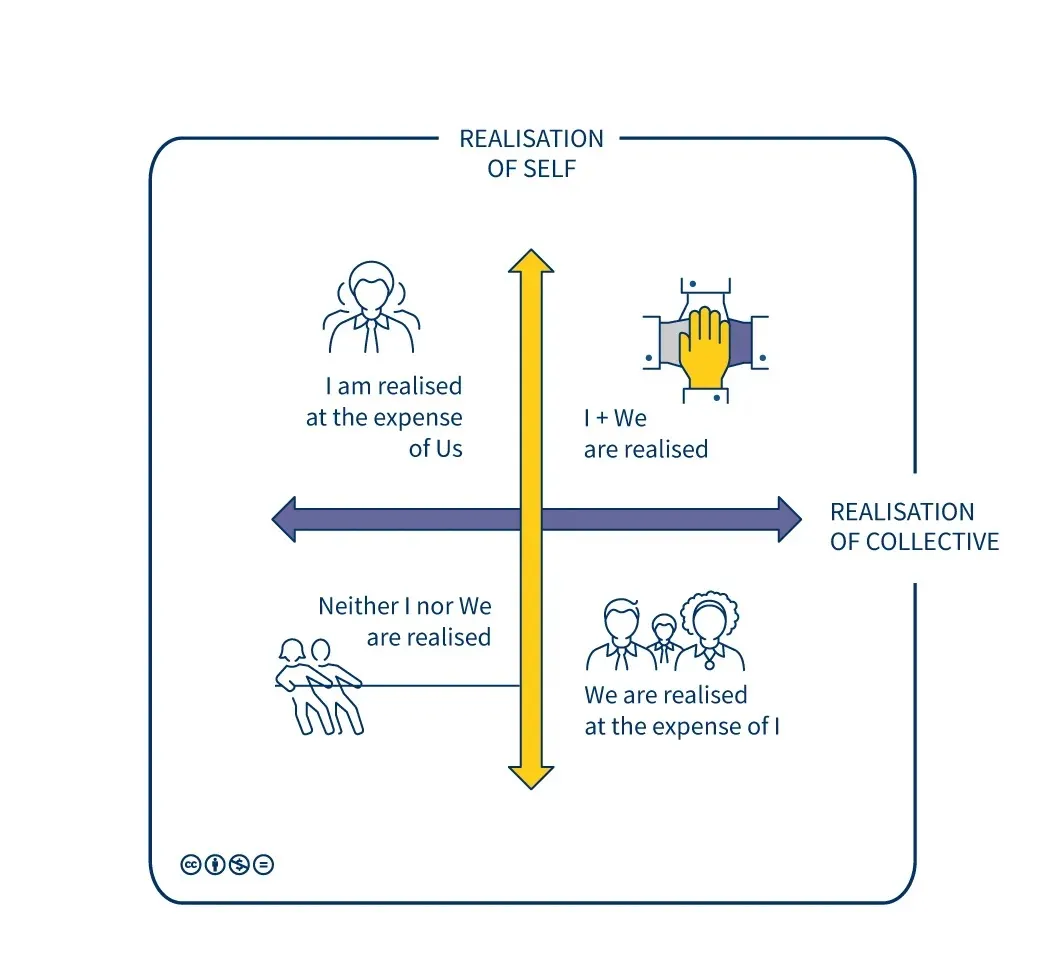
The Relational Imperative gives shape to this foundational dynamic through a simple x–y graph. Though the graph may appear straightforward at first glance, it carries the same depth and complexity as Carson's reminder that “nothing exists alone.” At its core, the graph captures the state of a relationship at a given moment. For example, when I apply the Relational Imperative to reflect on my relationship with my wife, I don't place myself on one axis and her on the other. Instead, the Relational Imperative positions me (or her, depending on the focus of our dialogue) on the y-axis, and our marriage itself on the x-axis.
Our marriage is placed on the x-axis of the Relational Imperative because it serves as our relationally bounded unit, the shared space of our collective becoming. It is the context, the container, the ground of our relationship. In a real and tangible way, our marriage takes on a life of its own. We tell stories about it, make choices in light of it, and carry it with us in memory and intention. It has been woven together through countless small interactions and decisions. We cannot simply disregard each other without risking the very life we've built, a life neither of us wishes to lose. And so, once again, we find ourselves bound, shaping and being shaped by each other in ways both seen and unseen.
The first thing to notice about the Relational Imperative is how it places me on both axes. I appear on the y-axis as an individual, and on the x-axis, through my marriage, as part of a collective. This dual placement reflects our inherent interdependence, capturing the idea that “nothing exists alone.”
Secondly, it's important to recognise that the Relational Imperative is not just a simple 2x2 matrix. Instead, it's a graph with directional axes that symbolise growth. In our example, this reflects both my personal growth as an individual and the growth of our marriage. But growth toward what, exactly? This is perhaps the most challenging aspect of the Relational Imperative. Something that must be discovered and defined both individually and together.
Let's consider individual development. Numerous influential thinkers, from Erikson to Piaget to Jung, have deepened our understanding of this area. I'm especially drawn to Jung's concept of individuation; the ongoing integration of all aspects of the self, both conscious and unconscious. However, our understanding of individual development isn't limited to science. Across traditions, religions have long offered frameworks for inner growth; from the Buddhist path toward enlightenment to the Christian journey of Theosis, each pointing toward a deeper union of self and spirit.
When I think about growth, I think about moving towards greater peace and wholeness. To me, this is where true freedom lies. Not just as a feeling, but as a way of being. To make sense of this, I find it helpful to frame things in ontological terms. Ontology, simply put, is the branch of philosophy concerned with the nature of being. Viewed this way, the axis represents the “power to be.” As I traverse this axis, my power of being increases or decreases. We'll leave the deeper ontological exploration for another time, but one insight is worth carrying forward: as something is realised, as it matures and grows, it also gains in power. Not the power to dominate, but the power to be itself, fully, freely, and faithfully.
One of the most important things you can do for yourself is to hold a clear picture of what growth looks like in your own life. Too many of us lack clarity about who we are or who we hope to become. Sometimes we cling to an identity that no longer fits, or perhaps never truly did. The truth is, if you don't choose for yourself, you leave space for others, whether individuals or the broader culture, to choose it for you.
While we get to choose what growth looks like in our own lives, we don't, and shouldn't, make those decisions alone when it comes to our collective realisations. Returning to our example, I don't get to choose for my marriage. That is a decision my wife and I make together. Something we learn about and discover along the way, as we do life together.
The Core Assumption of the Relational Imperative
With this understanding of the two axes, that they represent growth, and that I exist on both, we arrive at what I believe may be the most important implication of the Relational Imperative: that my realisation is intimately bound to our realisation. It sounds simple, even obvious, but living as if it were true is something else entirely.
Of all my personal flaws, the belief I've worked hardest to unlearn is the idea that my realisation is something I can achieve on my own. I've wrestled with this for decades, and I still have a long way to go. Whatever progress I've made has not come from within me alone, but from the conversations I've had with a community I trust to speak honestly into my life. They help me see myself more clearly, challenge me, support me, and remind me to give myself a break now and then. I'm deeply grateful to have them in my life.
The Relational Imperative as a heuristic
This, then, is the purpose of the Relational Imperative: it offers a simple heuristic for examining the shape of our relationships through the lens that nothing exists alone. It helps us recognise not only that we need each other, but that we become who we are through each other.
The Relational Imperative can be visualised as a graph (see image) that captures how this core belief is expressed at any given moment. In doing so, it reveals four basic relational states, each of which can vary in intensity.
I + We are realised
I am realised at the expense of Us
We are realised at the expense of I
Neither I nor We are realised
The Relational Imperative.
The Relational Imperative in Practice
I use the Relational Imperative most directly in my role as a people manager. The process begins with a staff member identifying two or three key relationships that most shape their experience within the company. From there, we map the current state of each relationship from both perspectives. When exploring their relationship with the company, we place the individual on the y-axis and the company on the x-axis. As part of the initial conversation, we discuss what realisation looks like, for both the individual and the organisation, framed by professional development and existing organisational goals. Each of us then places a point on the Relational Imperative to reflect our sense of how fully both the individual and the collective are being realised. More often than not, our points are close, but not quite the same.
The goal of the exercise isn't to convince one another whose assessment is more accurate, but to spark meaningful dialogue about what is actually happening in the relationship. Sometimes the conversation is brief; other times, it calls for a deeper dive into one of the axes to clarify what ‘realisation’ means for each party.
The ultimate aim of these conversations is always to explore how we might move both points higher towards the top-right quadrant of the graph, where both the individual and the company are safe and growing. We call this shared goal right-relationship.
We also use the Relational Imperative as a lens to critically examine interactions and experiences within the workplace. Take, for example, a range of workplace moments that might fall into each quadrant of the graph, with each reflecting a distinct state of relationship:
Bottom-right quadrant (the collective is realised at the expense of the individual): Workplace demands are so high that they begin to erode an employee's personal or family life, leaving them overextended and unseen.
Top-left quadrant (the individual is realised at the expense of the collective): An employee uses their position to dominate discussions or silence others, prioritising personal expression at the cost of team cohesion.
Top-right quadrant (where both the individual and the collective are realised): An individual creates a collaborative space where ideas are shared, contributions are acknowledged, and both personal growth and team success are nurtured.
Bottom-left quadrant (neither the individual nor the collective is realised): Misalignment on values, unclear expectations, or persistent communication breakdowns leave both the individual and the organisation underperforming.
And because relationships are never fixed, always in motion, always becoming, every word, gesture, or silence is an opportunity to exercise the power of the ‘I’ or the collective ‘We’ to realise, empower, disempower, or overpower. Over time, these small choices accumulate, shaping not only our individual experiences but the broader relational culture in which we live and work.
This is why the top-right quadrant, what we call right-relationship, matters so much. It reflects a deliberate commitment to valuing both the individual and the collective. It speaks directly to the kind of culture we aim to build within the organisation: one that not only respects its people and performance but understands that the two are inseparable. Cultivating right-relationship isn't just a cultural aspiration; it is a strategic priority that strengthens engagement and drives meaningful performance.
Not all relationships are created equal
One of the strengths of the Relational Imperative is that it can be used to explore the relationship between two people just as readily as the dynamic between a person and their team, organisation, or even the state. While a single graph is not designed to capture the full complexity of a relationship, it offers a meaningful snapshot of how one person or group perceives the current balance, or imbalance, within it. And because it applies across relational scales, a series of these snapshots can begin to reveal the deeper patterns that shape how we relate, both up close and across the broader structures we are part of.
Yet even across these varied scales, not all relationships carry equal weight. Some exert more influence on our lives than others, shaped by the strength, depth, or context of the bond. These may include the emotional connection with a loved one, the shared commitment of a team, the legal relationship with the state, or the social license that allows a company to operate within a community. Some ties live close to the heart; others remain at arm's length.
Still, whether intimate or distant, certain relationships stand out for their impact. This reflects the 80/20 principle, first observed by economist Vilfredo Pareto, which suggests that in many contexts, a small number of causes produce most of the effects. In relational terms, a handful of connections often shape the majority of our joy, emotional energy, growth, and stress. These relationships carry disproportionate weight and deserve our fullest attention, not just because they profoundly shape us, but because we inevitably shape them as well. They call for care and intention, precisely because our stories are inseparably woven together.
The Unseen Weight of Relationship
Beyond the core relationships that most influence our lives, the 80/20 principle also reminds us of the long tail of everyday choices and interactions that may seem small on their own, yet when repeated across populations, have a profound impact. Think of the emissions from a single car ride, the energy behind each flick of a light switch, or the hidden cost of fast fashion. These acts may feel distant or insignificant, but together, they quietly reshape the climate and ecosystems we all depend on.
Leonard E. Read's classic essay I, Pencil offers a vivid illustration. He describes the extraordinary number of skills, professions, and processes required to make something as simple as a pencil. From the lumberjack felling cedar trees, to the miner extracting graphite, to the chemist mixing lacquer, each person brings a specialised craft. No one person knows how to make a pencil on their own; it emerges through a vast web of cooperation, coordination, and trust.
Read's point is that the market enables this intricate collaboration not through central control, but through decentralised effort. Yet here's what we often overlook: while the value of the pencil is immediately clear, we rarely consider what we lose in that decentralisation. Beyond the thirty cents we pay, something else quietly slips away: our proximity to the relationships behind it. The pencil in my hand feels distant because we do not walk in the forest where the cedar was felled, nor do we share a meal with the miner who brought the graphite to light.
These relationships are real but remote, leaving us with a pressing question: who carries the weight of responsibility for them? How do we account for the unseen, the far-off, the lives and ecosystems touched by even the smallest actions we take and the everyday objects we hold? Where does our responsibility begin, and where does it end? These are questions for another time. For now, it is enough to say that the Relational Imperative turns our attention outward, reminding us that we are connected, and that these ties are not abstract, but made of families, communities, forests, and rivers.
I'll end with this thought. If the crisis of our time rests on two conflicting truths, first, a forgetting that nothing exists alone, and second, a rising global hyper-connectivity that overwhelms the social and environmental layers that once held us, then perhaps what we need is a counterbalance: a hyper-awareness of our interdependence. The Relational Imperative invites us into this awareness, to see differently, to act with greater care, and to value right-relationship for all, not just a few. It may not offer easy answers, but it might help us find our way forward. One thing is certain: we will need every tool at our disposal, from the simple and practical to the sacred and sublime.