“Only love attracts all human beings. The attraction of love is unlimited. And educated and uneducated, rich or poor, skilled or unskilled, beautiful or ugly, healthy or sick, and young or old — all want to be loved.”
After my father died, I sat down to write his eulogy. I looked at the blank page, and a question surfaced, quiet at first, then insistent. Did my father love me? The funeral was days away. I still could not find a way to begin. Every memory felt tangled. I waited for something to come loose.
Eventually, I reached for a book I had nearly forgotten. Twenty years earlier, I had picked up a copy of Paul Tillich's Love, Power, and Justice in a secondhand bookstore. That little book had followed me across continents, survived a bushfire, narrowly escaped being resold, and endured years of neglect, until the month my father died, I finally read it.
As I sat with my grief, Tillich's words met me with unexpected force. They did not console me, but they did something more useful. He set love, power and justice in relation to one another. His understanding of love as “the drive toward the unity of the separated” still felt cold and abstract, yet the way he bound these forces in a kind of moral entanglement, where each moved in response to the others, changed how I saw my father and the nature of relationship itself. Something in me began to shift.
That shift has led me here, to the quiet but persistent ambition of this essay: to explore the nature of love, not only as a feeling but as something deeply personal and endlessly complex. Love resists easy definition. It spans time and culture, shaped by memory, longing and hope. We all long to be loved, as St Velimirovich observed, yet when we reach for it, love slips through our fingers. Still, the reach matters. For in reaching, we may find that love is not something to be grasped, but something to be met, a living presence, full of wonder, waiting to be embraced.
One of the greatest problems of history
I could conclude this essay just as quickly as I began it, with the following quote from a speech Dr. Martin Luther King Jr. delivered in 1967.
“One of the great problems of history is that the concepts of love and power have usually been contrasted as opposites — polar opposites — so that love is identified with a resignation of power, and power with a denial of love….We've got to get this thing right. What is needed is a realization that power without love is reckless and abusive, and love without power is sentimental and anaemic. Power at its best is love implementing the demands of justice, and justice at its best is power correcting everything that stands against love.”
Dr. Martin Luther King Jr., 1967
There is a beauty in these words that makes their truth hard to ignore. Yet they also uncover a troubling reality. As Dr. King observed, “One of the great problems of history” is that we lack an understanding of love, power, and justice that truly serves us. Take justice, for example: it is unsettling to realise that even a terrorist believes their actions are just. And in a way, many of us are not so different, though on a much smaller scale. We often justify our own harmful actions by pointing to circumstance.
As Dr. King observed, “One of the great problems of history” is that we lack an understanding of love, power, and justice that truly serves us.
Why, then, do our understandings of justice diverge so widely? And what does this mean for how we understand love? With such differing views on what is just, how can we ever hope, as Dr. King challenged, to “get this thing right”?
The different faces of justice
In Western society today, the political landscape rests on two dominant understandings of justice: equality of outcome and equality of opportunity. These principles anchor the contrasting worldviews of the political Left and Right, respectively. Yet in practice, the pursuit of justice often places these ideals in tension, creating a paradox that divides the very society it seeks to serve.
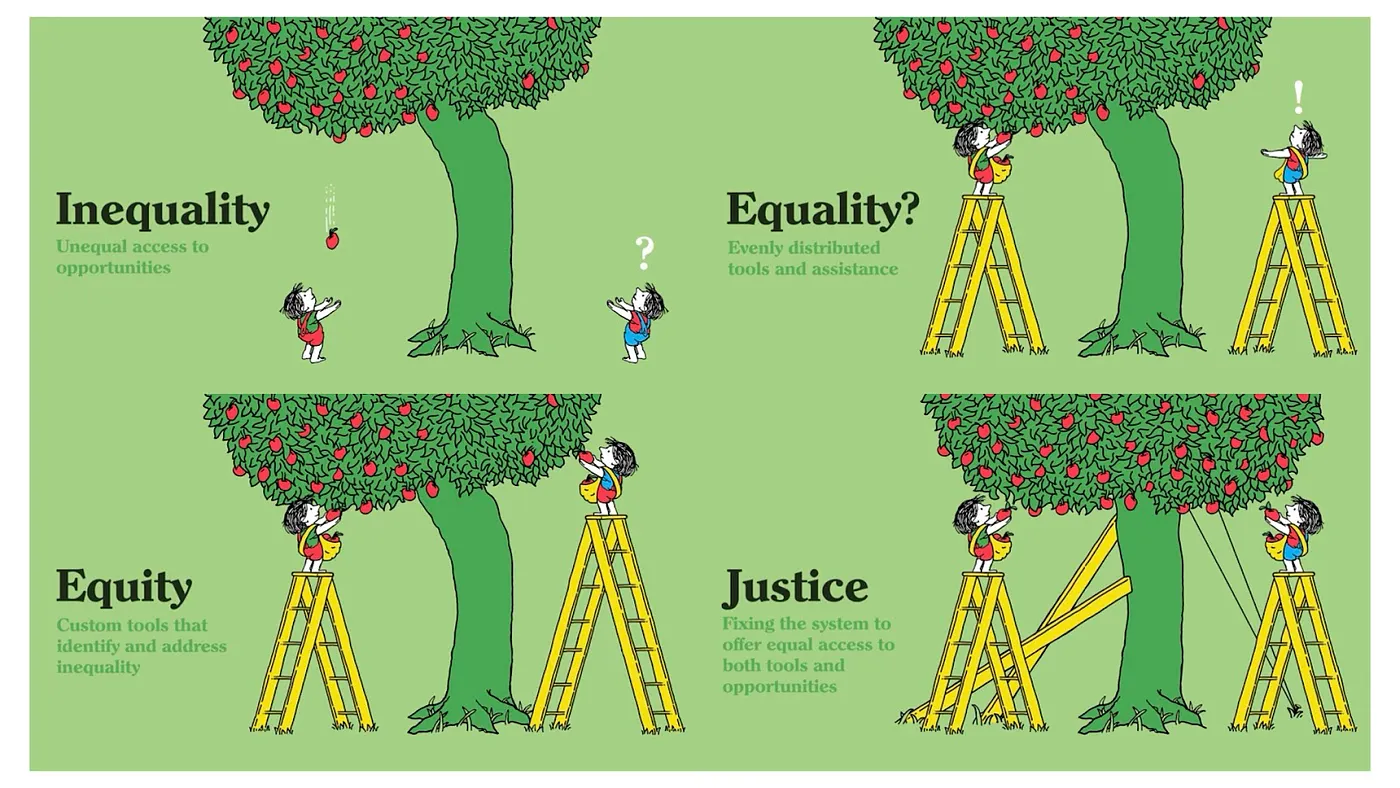
In my work in economic development and impact investing, I occasionally encounter this tension as it plays out within real-world economies. Each ideal, equality of outcome and equality of opportunity, seeks to shape economic realities in its own way. To better grasp this tension, consider the cartoon below, which offers a simple but vivid illustration of these competing visions in action.
Figure 1. 2019 Design In Tech Report | “Addressing Imbalance” Illustrations by @lunchbreath
In the first panel, the cartoon sets up the core problem: inequality, depicted through the uneven distribution of apples. It raises a central question: how can we correct this unfairness? The cartoon then offers three potential solutions, each illustrating a distinct way to approach the challenge of achieving justice.
The first solution, shown in the second panel and labelled simply as equality, focuses on providing equal opportunity. Everyone receives the same tools and resources to achieve their goals: in this case, identical ladders to reach the apples. Yet while this seems fair on the surface, it can unintentionally deepen inequality, because identical resources do not guarantee equal outcomes. Ironically, if equal outcomes are the goal, treating everyone the same might actually push us further from that goal.
The next solution, labelled equity, takes things a step further by accounting for each person's unique circumstances. Instead of distributing the same resources to everyone, it provides each character with a ladder specifically suited to their needs. This brings the system closer to ensuring both individuals receive a fair share, a meaningful improvement, though it stops short of fully closing the gap.
Finally, the cartoon presents justice, suggesting it is achieved by addressing systemic inequalities directly, fixing the underlying conditions within the system itself. Once these deeper issues are corrected, equal opportunity becomes genuinely fair, as everyone can now make effective use of identical resources on a truly level playing field.
However, the cartoon begins by framing unequal apple distribution as the core problem. But even after addressing systemic issues, what prevents one character from simply taking more than their share? Wouldn't this risk recreating the original inequality? To achieve true justice, would we then need an arbiter, perhaps a central authority, to ensure fair distribution? Or has inequality suddenly become acceptable simply because the playing field is now level?
Of course, society's understanding of justice isn't neatly divided into two opposing views. Many theories offer more nuanced perspectives. For example, John Rawls's Justice as Fairness emphasises impartiality and prioritises equality of opportunity, allowing inequalities of outcome only when they benefit society's least advantaged. By contrast, Robert Nozick's Libertarian Justice advocates minimal intervention, endorsing formal equality of opportunity while firmly rejecting any attempt to enforce equality of outcome.
Yet perhaps the cartoon's premise is flawed. Maybe justice isn't only about how resources are distributed. While fairness in sharing matters, is it truly the foundation on which we should build our understanding of justice? Consider, for example, a Utilitarian perspective, where both equality of outcome and equality of opportunity are viewed as means to a larger end: maximising overall happiness.
But is happiness really the right goal? It may seem fine for us as humans, but what does happiness mean for the environment? As our little characters pluck apples from the tree, who is caring for the tree itself?
Perhaps the true lesson of the cartoon lies elsewhere. Maybe it teaches us that justice is far more complex and interconnected than it first appears. That justice for one is rarely justice for all. As John Muir so beautifully observed, “When we try to pick out anything by itself, we find it hitched to everything else in the Universe.” Could it be that beneath these competing ideals lies a deeper framework, one that draws us toward a more expansive understanding of the nature of love?
Maybe it teaches us that justice is far more complex and interconnected than it first appears, that justice for one is rarely justice for all.
Looking through the lens of the Relational Imperative
In an earlier piece, What Lies Between Us, I argued that building a good society requires shifting the center of our moral universe, moving away from a singular focus on either the individual or the collective, and turning toward what-lies-between-us: relationship. This shift is captured in the Relational Imperative, which now serves as our guide as we continue exploring justice and love. If you're unfamiliar with the Relational Imperative, I encourage you to explore a fuller introduction here. For now, I'll offer a brief overview.
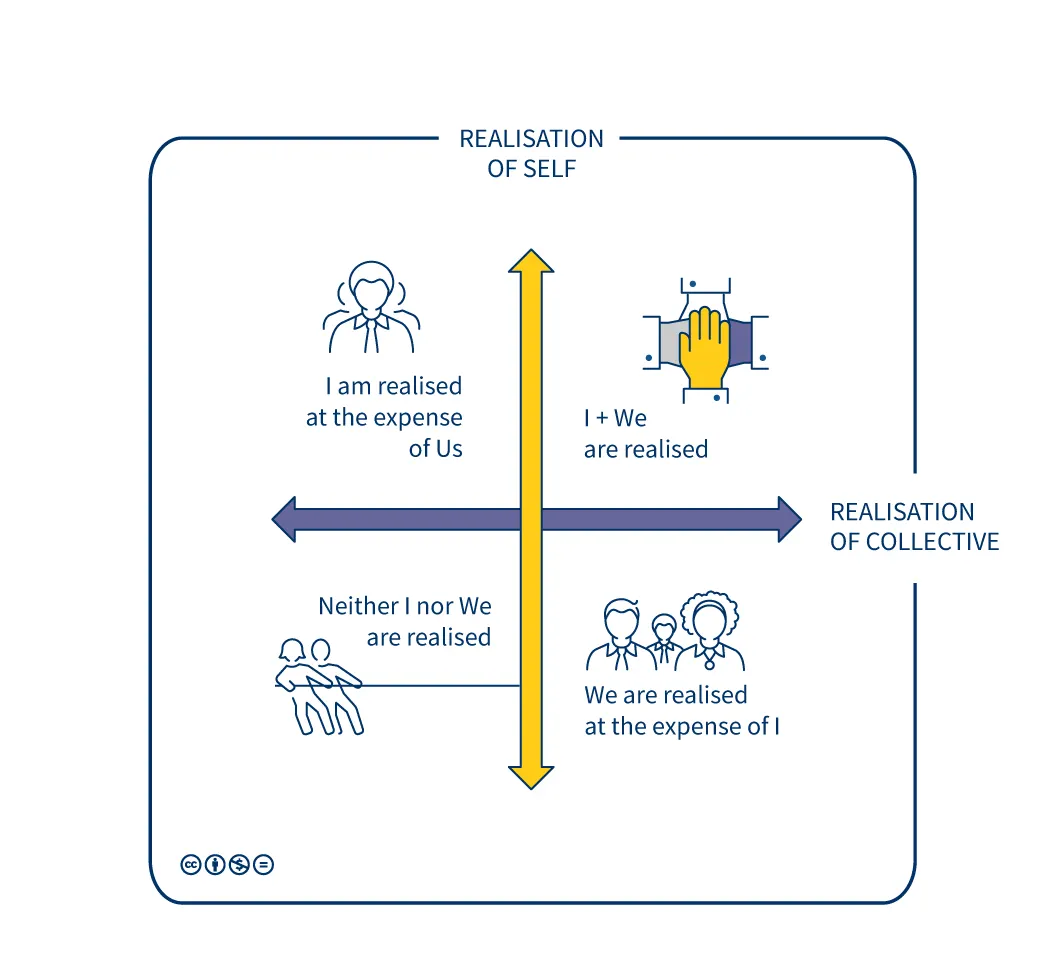
The Relational Imperative is a heuristic, illustrated as an x-y graph, that deepens our understanding of the belief that “in nature nothing exists alone.” This principle suggests not only that we need one another, but also that we become who we are through our relationships with each other. Though the graph may seem simple at first glance, it holds within it the same depth and complexity as the principle it represents.
At its core, the graph captures the state of a relationship at a given moment. For example, when applying the Relational Imperative to my relationship with my wife, I don't position myself on one axis and her on the other. Instead, the Relational Imperative places me (or her, depending on the focus of the dialogue) on the y-axis and our marriage itself, the relationship we share, on the x-axis.
The first thing to note about the Relational Imperative is this: assigning the axes in this way places me on both. I exist on the y-axis as an individual and on the x-axis as part of the collective we create through our marriage. This dual placement reflects our inherent interdependence, capturing the heart of the idea that nothing exists alone.
The first thing to note about the Relational Imperative is this: assigning the axes in this way places me on both.
Secondly, it's important to recognise that the Relational Imperative is not merely a simple 2x2 matrix. Rather, it is a living graph with directional axes that symbolise growth. In our example, this represents both my personal growth as an individual and the growth of our marriage as its own collective unfolding. But growth toward what, exactly? That is perhaps the most challenging and most vital aspect of the Relational Imperative because it is something that must be discovered and defined both individually and together.
Our final point here is that mapping the state of a relationship ultimately means mapping the expression of power between the individual and the collective from moment to moment. Whether we are looking at a person within a marriage, a player within a team, a team within a company, or a citizen within a state, power is always present, shaping the interaction between the “I” (on the y-axis: person, player, team, citizen) and the “We” (on the x-axis: marriage, team, company, state).
Because this power is realised in relationship, it is always in motion. Each choice shifts the balance between the I and the We, enabling either the individual or the collective to empower, uplift, disempower or overpower the other. That motion does not stop at the boundary of a single relationship, since no relationship stands alone. Each is nested within larger systems that are dynamic and linked to the rest. Influence flows both ways. Small shifts move out as ripples and return as waves. What happens in one moves through them all.
In our distilled picture, however, the dynamic process reveals four basic relational states:
I + We are realised
I am realised at the expense of Us
We are realised at the expense of I
Neither I nor We are realised
Figure 2. The Relational Imperative.
With the Relational Imperative (re)introduced, we can now use it as a lens to deepen our exploration of justice. I have come to see the four quadrants not simply as relational states, but as expressions of deeper assumptions, the underlying beliefs that shape how we understand the world and justice. The quadrants reveal different foundations for justice because each one illuminates a distinct way we can value, privilege and attend to relationship. Seen through this lens, concepts like equality of outcome and equality of opportunity emerge from different ways of attending, each privileging a different aspect of the “I–We” dynamic.
The quadrants reveal different foundations for justice because each one illuminates a distinct way we can value, privilege and attend to relationship.
Take, for example, the concept of equality of outcome. In this worldview, justice seeks to ensure that everyone ends up with the same, defining fairness through uniform distribution. It prioritises equality within the collective, often emphasising sameness over individuality. While it aims to eliminate disparities, it can diminish the uniqueness that defines us as individuals. Here, morality is rooted in the collective, where justice is achieved when resources or outcomes are evenly shared, regardless of personal circumstances. This emphasis on the collective, sometimes at the expense of individual distinctiveness, aligns with the bottom-right quadrant.
Now consider the concept of equal opportunity. In this worldview, justice aims to give everyone the same starting point by removing barriers so that differences in outcome arise from differences in choice or effort. Here, individuality is valued over uniformity, and the focus shifts to recognising personal differences, needs and abilities. From this perspective, unequal outcomes are not a failure but the expected result of a fair process. Morality centres on the individual. Justice is served when the same formal opportunities are available to all and outcomes follow from merit and choice. This emphasis on the individual over the collective aligns with the top-left quadrant.
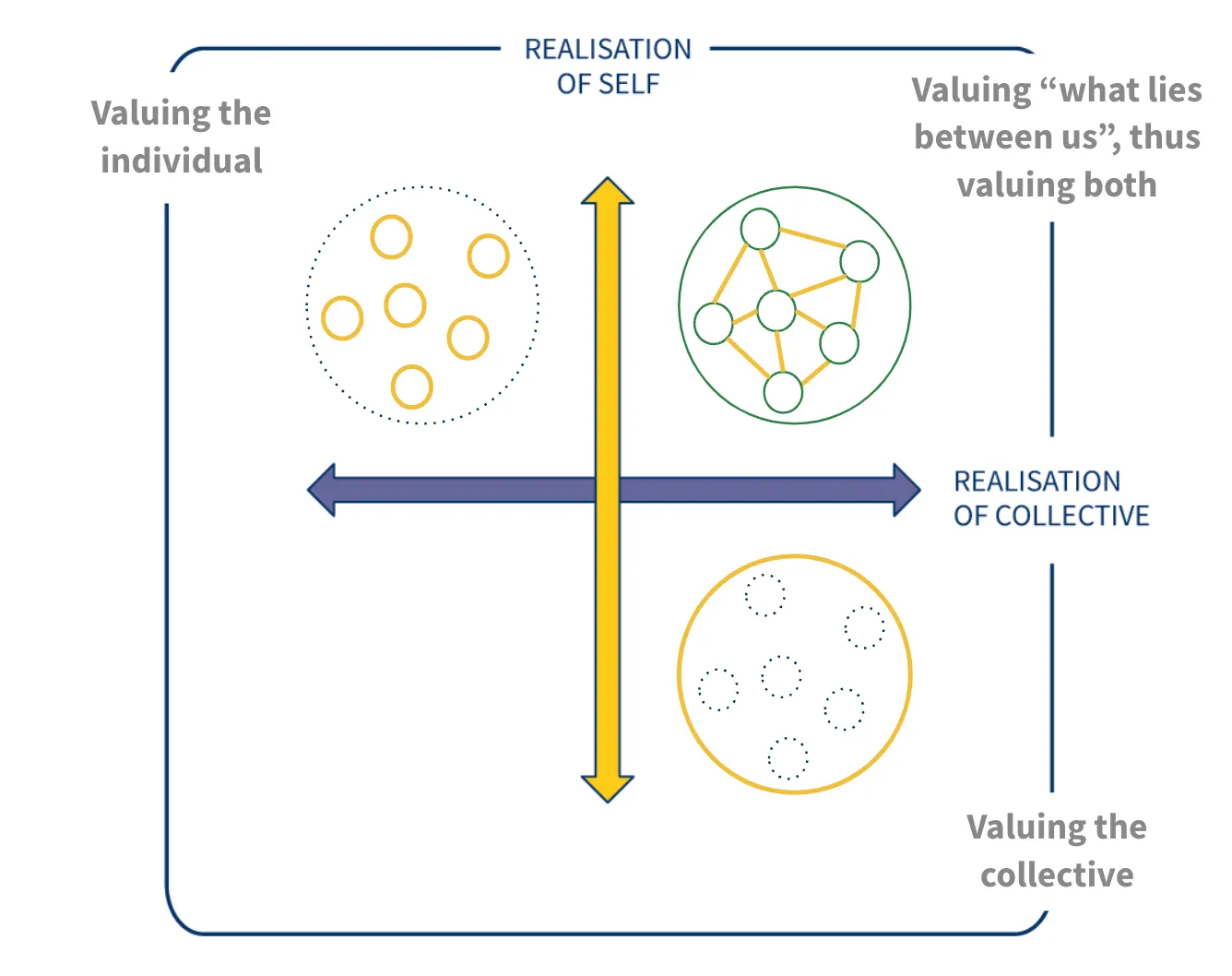
What this tells us is that our understanding of justice is not fixed. It shifts depending on what we choose to value, privilege and give our attention to. The Relational Imperative makes this visible by showing how each way of attending to relationship generates a different moral starting point. This is illustrated in Figure 3.
What we give our attention to does more than shape what we notice; it shapes how we see. This is not a straightforward, linear process but a reinforcing loop that draws us deeper into a particular perspective, gradually shaping our entire worldview. When our attention is fixed on the bottom right, we prioritise the collective, elevating the whole above the individual. When our gaze is fixed on the top left, we centre the individual. Each focus pulls us further into a distinct vision of justice and reality, shaping not only our perceptions but also our values and choices.
Figure 3. Where attention is given within the Relational Imperative.
In his book “The Geography of Thought: How Asians and Westerners Think Differently…and Why,” Richard Nisbett observed that Western societies tend to prioritise the individual, while Eastern societies emphasise collective social structures. Yet, as Nisbett points out, reality is rarely that simple. Societies do not simply choose between the individual and the collective nation-state. Some place the highest value on immediate family, while others elevate extended familial structures such as clans and tribes. Across cultures, there exists a rich spectrum of relational scales that societies may choose to prioritise.
My point here is not just to highlight the diversity of these choices, but to emphasise that as societies have evolved, each has made deliberate decisions about which relational scale to prioritise. Decisions that have shaped their entire worldview. These choices, in turn, determine where attention is directed and what is held most sacred in their pursuit of justice.
By privileging one relational scale over another, we inevitably sow the seeds of discontent. But is this the only path before us? Must we always choose a single, or even multiple, scales upon which to build a society? Is it necessary to elevate one way of relating above all others, or might there be a way to create dialogue between these scales without placing one above the rest?
A third way
This brings us to the top-right quadrant, where the focus turns from privileging either the individual or the collective toward what lies between us: relationship. Here, relationship itself takes precedence. By placing the relationship at the centre, we open a space that honours both the individual and the collective, allowing neither to diminish the other. It is a movement toward the coexistence of unity and multiplicity, where the many remain distinct yet move together as one. This approach is not a compromise but a fundamentally different path, a third way in which the dialogue between scales becomes the foundation rather than the battleground for building a good society.
Adopting the perspective of the top-right quadrant means recognising that relationship is the ground of justice. Viewed through this lens, our cartoon invites us to consider not only the interaction between the two characters but also the role of the tree and its connection to the broader ecosystem. A relational perspective reminds us that justice for one rarely translates into justice for all.
This worldview calls for dialogue, a deep listening that seeks to understand how our actions ripple through the lives of others. It invites us to care for our neighbours as we care for ourselves, recognising that our well-being is inseparably tied to theirs. It is a commitment to nurturing the potential of both the individual and the collective, one that asks for a radical reorientation of our attention and a courageous re-examination of what we truly value.
This commitment to relationship is not just an abstract ideal; it's something I've had to learn to practice in my own life. When my wife and I argue, and cooler heads prevail, our guiding question becomes: Are we drawing closer to each other or moving apart? This shift in perspective steers us away from the urge to win or persuade and toward engaging in meaningful dialogue that addresses the heart of the issue. Over time, we've come to believe that healthy relationships aren't simply byproducts of happiness; they are the foundation that makes lasting happiness possible.
This is an example of top right behaviour, where a third path to justice emerges beyond familiar symbols. It looks past the figure of Lady Justice, the blindfold signalling impartiality, the scales keeping account in an eye-for-eye measure, and the sword enforcing retribution. Here, justice is not primarily about balancing a ledger or delivering penalties, but about something more foundational.
That foundation is the restoration and strengthening of relationship. This vision of restorative justice extends an invitation, one that calls for grace and mutual commitment. It creates the space where ruptures can be acknowledged, healing can take root, and connection can be rebuilt. A space where both the “I” and the “We” stand strong together, each upheld and made more whole by the other.
It's important to clarify that I am not advocating for grace from a victim toward an abuser. Such situations lack the genuine commitment required for a mutual relationship. At its heart, grace is an invitation into relationship, and true relationship can never be imposed; it requires a willing, mutual response. Just as in my relationship with my wife, this form of justice demands that both parties actively move toward one another.
This mutual response calls for vulnerability, humility, and above all, honesty. It asks us to take responsibility for our actions, to extend forgiveness when it is needed, and to seek it when it is ours to ask. The path is often demanding and difficult, yet if we believe that a steadfast commitment to relationship is the foundation of true happiness, then the real question is not whether we will choose it, but how could we possibly choose otherwise.
Love as a commitment
This brings us to our first definition of love: at its core, love is a mutual commitment to a just relationship where both the individual (“I”) and the collective (“We”) are upheld and strengthened by each other. It is the living expression of right-relationship, a dynamic space where the needs of both are not just balanced but tended with care, where each gives shape and strength to the other. Love, in this sense, is neither passive nor fleeting; it demands intention, effort, and a willingness to sustain this delicate dance. The truest measure of love is therefore not found in words or emotions, but in the depth of our commitment to live this way of being into reality.
The truest measure of love is therefore not found in words or emotions, but in the depth of our commitment to live this way of being into reality.
To love, then, is to commit not only to joy and peace but also to hardship, pain, and the weight of real consequences. Love is not merely about basking in the light; it is about standing together in the shadows. And within those shadows, we encounter our own brokenness and the brokenness of others, along with our differing capacities to care for both the “I” and the “We.”
Yet when there is a shared commitment to right-relationship, we lay a foundation of hope, not a passive hope, but one born of trust. This kind of commitment signals that neither party is walking away, even when things are difficult. It creates the safety needed for honesty, the space where brokenness can be named and healing can begin. In that space, we grow in our relational capacities. Love, like the journey toward wholeness, meets us not in ease, but on the far side of the trials we've walked through together.
It was here that I found the answer to my question: Did my father love me? He never gave up on me, and I never gave up on him. Though we were both limited by our brokenness, we each tried our best, and we never gave up on each other.
Love isn't always about grand gestures or flawless affection. It's about the steadfast presence in each other's lives and the unwavering commitment despite our flaws and limitations. My father, though imperfect, showed his love by never surrendering to the weight of his brokenness, and for that, I love him dearly.
Love as the affirmation of life
Love, as a mutual commitment to right-relationship, has one final thing to teach us. Since “in nature, nothing exists alone,” this commitment cannot be confined to ourselves or our immediate relationships. It calls us to reach beyond the familiar, embracing all “I's” and “We's.” In its fullest expression, love recognises that every relationship, no matter how distant, is “hitched to everything else in the Universe.” By affirming these connections, we affirm all living things, and in doing so, love becomes known to us as the affirmation of life itself.
To love is not merely to care for those closest to us, but to recognise that our thriving is bound up with the thriving of others, of communities, ecosystems, and even the unseen forces that sustain life. It is an acknowledgement that the same breath moves through us all, that the pulse of life within one echoes through the whole. In this way, love becomes more than just an emotion or a choice. It transforms into a sacred affirmation of existence. An unwavering yes to life in all its forms.
In this way, love becomes more than just an emotion or a choice. It transforms into a sacred affirmation of existence. An unwavering yes to life in all its forms.
The other faces of Love
The story of love does not end here. Just as we examined justice through the lenses of the Relational Imperative, we can now turn to love and consider how it unfolds within the different worldviews of each quadrant. When we do, two familiar narratives come into focus, first in the bottom right, then in the top left.
The bottom-right quadrant tells a story of self-sacrificial love, the kind that calls us to set aside our own needs and desires to serve others. This was the story I was taught to believe and value growing up, the story that was modelled for me. It is a love often celebrated, even idolised. Perhaps you have experienced this kind of love or felt the weight of its expectations. There is undeniable beauty in such devotion, yet there is also a danger. When it is left unchecked, this love can drain one side of the relationship, leaving the giver empty, and it can plant seeds of unworthiness in the other, closing the door to reciprocity. Without being balanced by a right love of self, this love risks becoming a pathology.
The true beauty of self-denial in love lies not in sacrificing the self for the sake of the We, but in letting go of what hinders wholeness, gathering and integrating the parts of yourself that keep you from bringing your full self to the relationship. Only a whole self can fully receive love in return. Only then can mutual realisation deepen. Love, after all, is not a zero-sum game.
The narrative of the top-left quadrant centres on self-love. It has become one of the ailments of our time. Our social and economic structures reward independence and often embed this story within us without our noticing. Yet the beauty of self-love lies in its mutuality. Loving myself means knowing my limits and voicing my needs so that together we can care for both us and me. Without the counterweight of love for the We, the love of I folds in on itself. We are left isolated, and in the end, on our knees, in need of a new story.
Seeing the story of love anew in the age of broken relationship
We are living in an age of broken relationship, from our fractured connection with the planet, driving the sixth mass extinction and climate change, to the epidemic of loneliness and polarisation flowing from our broken relationship with each other and ourselves. Everywhere we turn, we see dysfunctional narratives of love playing out. As Dr. King reminded us, “We have to get this thing right.”
I believe the Relational Imperative invites us to see the story of love with fresh eyes. But let me be clear: I'm not suggesting love can be neatly captured in our 2x2 graph. Love defies such simplification.
In fact, this irreducibility illuminates something central to love's nature, as captured in Martin Buber's description of the I-Thou relationship: “If I face a human being as my Thou, [they are] no thing among things … not a condition to be experienced and described, a loose bundle of named qualities. But whole in themselves, they are Thou and fill the heavens.” When we meet another as Thou, not It, we step into something alive and sacred. A space where we see the other not as a means to an end, but as an end in themselves, worthy of reverence and response. It is within this space, beyond measure or control, that love reveals its fullest depth: real, alive, and irreducible.
And yet, despite this, we are shaped by a world Buber calls the I-It. A world shaped by propositions and material outcomes, by the objective (top-left quadrant) and the subjective (bottom-right quadrant). But the top right-hand quadrant points us beyond these categories, toward Buber's I-Thou world: a what-lies-between-us world, a relational ontology in which the very ground of being is not substance or object, but relationship itself. A reality that, by its nature, resists reduction.
Even so, in this age of broken relationship, the I-Thou, the space of what-lies-between-us, remains within reach. We encounter it in nature, where the living world meets us not just as a resource to use, but as a presence to behold and tend with care. We hear it in our Scriptures, where love, justice, and awe call us into right relationship. And we discover it within ourselves and others, presence to presence, through capacities like empathy. That remarkable crossing beyond our own experience, where we glimpse the world through another's eyes and, even if only for a moment, share in their life.
Yet here lies the challenge: our capacity to live in I-Thou relationship (in right-relationship, in loving relationship) has evolved to thrive at the human-to-human scale. But this capacity begins to thin as we approach the edge of what we can meaningfully hold, what social scientists call Dunbar's number, placing it at around 150 relationships. Beyond that, we begin to sort people into categories, and it becomes far easier to dismiss or harm a group labelled as other than it is to dismiss or harm a person we know by name, face, and story.
How, then, do we carry this capacity further? How do we extend this way of relating, this intuitive, immeasurable capacity, so it can function across broader relational scales, beyond the small circles we can personally hold?
I believe this question stands as the defining challenge of our time, the central fault line beneath this age of broken relationship.
Dr. King understood this well, reminding us that meeting such a challenge is not merely structural or political, but a moral and imaginative task. One that asks us to reimagine how love moves through power and shapes justice.
The story of love we have traced here does not resolve into a definition. It opens into an invitation, a call to shared responsibility for one another and for all living things. When relationship becomes our ground, the place from which we think and act, we learn to move with care between the needs of the one and the many and to find wisdom in the tension that holds them together.
Practised in this way, love is not something to be grasped or controlled, but encountered. And when it meets us, it comes clothed in wonder. As Buber reminds us, “The world is not comprehensible, but it is embraceable: through the embrace of one of its beings.”